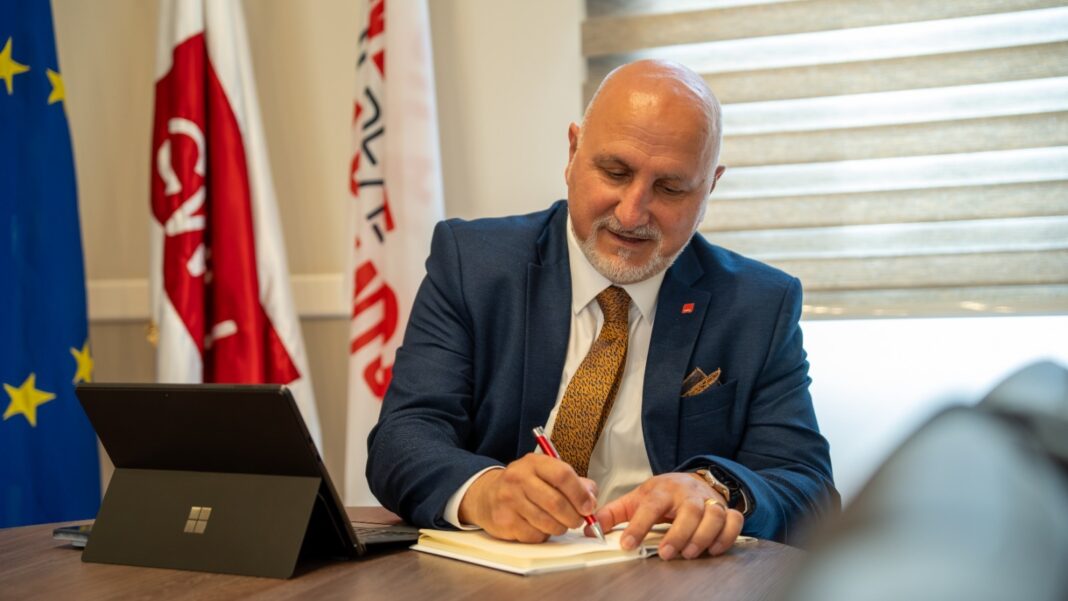
“The Budget should be seen as a tool through which the Government encourages people to contribute to Malta’s progress”
Interview with GWU Secretary General Kevin Camilleri on the Union’s proposals for Budget 2027
“It is important that, when considering all the proposals put forward by the General Workers’ Union, we understand that these are not simply about what people will receive or what the Government will provide. The Budget must be viewed beyond its individual measures. It should be seen as a tool through which the Government encourages people to invest and contribute towards our country’s progress.”
This was stated by General Workers’ Union (GWU) Secretary General Kevin Camilleri during an interview with this newspaper, following the presentation of the Union’s proposals for Budget 2027.
Camilleri emphasised that the Budget should not merely be regarded as a collection of financial measures, but should provide a clear direction for Malta’s future. Through cooperation between the Government and the public, the objective should be to build a better future for Maltese and Gozitan workers and families.
He explained that the GWU’s proposals are based on the need to ensure that the country’s economic progress translates into tangible improvements in workers’ everyday lives, including quality employment, better working conditions, greater economic security and higher living standards.
A 32-hour working week: A proposal requiring careful study
One of the GWU’s main employment-related proposals is the introduction of a pilot project for a 32-hour working week, supported by comprehensive research and evaluation.
Camilleri explained that the intention is not to introduce a new working arrangement without adequate preparation, but to examine whether shorter working hours could be beneficial, particularly in light of the growing influence of Artificial Intelligence.
“The 32-hour working week should begin as a pilot project involving extensive research. We need to examine how Artificial Intelligence, which is already part of our lives and will become increasingly integrated into workplaces, could help us determine whether a 32-hour working week would be beneficial and feasible.”
He stressed that technological developments should be assessed in terms of how they can deliver practical benefits to both employees and workplaces.
COLA should be paid twice a year
Camilleri also addressed the need to reform the Cost of Living Adjustment (COLA) mechanism.
The GWU is proposing that COLA should no longer be paid only once a year, but instead be distributed through two payments annually, allowing workers to benefit from adjustments more regularly.
He argued that, in an economy where prices are constantly changing and the Retail Price Index is published monthly, workers should not have to wait an entire year to receive compensation for increases in living costs.
According to Camilleri, this change would make the mechanism more responsive to current economic realities and help workers manage their everyday expenses.
Artificial Intelligence must be regulated to protect workers
Another important proposal concerns the regulation of Artificial Intelligence in the workplace.
Camilleri warned that the increasing use of AI, without an appropriate regulatory framework, could create new challenges for employees and industrial relations.
“If Artificial Intelligence is not regulated, it will create problems. That is why we are insisting on legislation regulating the use of algorithms. Before these systems are introduced into workplaces, there must be discussion and social dialogue, with trade unions actively involved.”
He explained that the GWU wants technological innovation to be introduced responsibly and transparently, while safeguarding workers’ rights.
“We are insisting on this because, without regulation from the outset, controlling these systems at a later stage will become considerably more difficult,” Camilleri said.
Fairer energy subsidies and incentives for responsible consumption
Turning to energy policy, the GWU is proposing that existing subsidies should remain in place, while the way they are distributed should be reviewed to make the system fairer and more sustainable.
Camilleri recalled that the Union has consistently supported energy subsidies to protect households from rising costs. However, he believes the time has come to consider a mechanism that provides greater assistance to those who need it most.
“Subsidies must remain, but we need to change how they are distributed. Those who can afford the least should receive the greatest support.”
He explained that the system should also reward responsible energy consumption. Households with greater financial resources or less efficient consumption patterns could receive a lower level of subsidy, without losing support entirely.
Camilleri also referred to the substantial cost of energy subsidies, which, according to figures mentioned during the interview, is expected to exceed €400 million this year.
“With more careful planning, we could distribute these millions more effectively and redirect part of that investment towards other projects.”
Among the examples mentioned were solar panel installations and battery energy storage systems. He argued that more incentives should be introduced to help families generate and store their own electricity, reducing dependence on Enemalta’s national grid.
In this context, Camilleri also highlighted the pressure that population growth is placing on Malta’s infrastructure, stressing the importance of further investment in water supply and sewage systems to meet increasing demand.
Affordable housing and the possibility of a social bank
Affordable housing was another key issue discussed during the interview.
Camilleri expressed concern about workers who, despite being employed and making an effort to save, still struggle to purchase their first home.
He observed that some individuals contribute to the economy through their employment but are unable to qualify for a sufficiently large bank loan to purchase a property.
“We want to reward people who work hard, who are productive and who contribute to society. It cannot be acceptable that someone who works but does not earn a sufficiently high salary is unable to afford a home.”
The GWU is therefore calling for more affordable housing projects and is also raising the possibility of reintroducing a social bank in Malta.
Camilleri argued that these proposals should be considered alongside other initiatives designed to make homeownership more accessible to workers and families.
“These are ideas which, together with other proposals, can be developed to give as many people as possible the opportunity to purchase their own homes,” he said.
Active ageing and stronger cooperation between generations
Towards the end of the interview, Camilleri discussed Malta’s changing demographics and the need for long-term policies to address them.
He noted that Malta, like many other countries, is experiencing demographic changes, including an ageing population and a growing need to recognise the experience and knowledge of older people.
Reaching retirement age, he explained, does not necessarily mean that a person can no longer make a valuable contribution to society or the economy, provided they wish and are able to remain active.
The GWU is therefore proposing a stronger active ageing framework, offering opportunities for older people to remain engaged and share their knowledge and experience.
Camilleri also highlighted the importance of encouraging cooperation between different generations in the workplace.
“We should have a policy that brings together the experience of older workers with the energy and ideas of younger generations.”
He referred to research conducted by the GWU which, according to him, demonstrated that cooperation between workers of different ages can contribute to a more productive, resilient and positive working environment.
He maintained that the experience of older employees and the fresh perspectives of younger generations should complement one another.
A Budget that looks beyond immediate measures
Throughout the interview, Kevin Camilleri’s central message was that Budget 2027 should be viewed as an opportunity to plan for Malta’s future rather than simply as an annual financial exercise.
The GWU’s proposals address several areas directly affecting workers and families, including wages, employment conditions, energy, housing, technology and active ageing.
For the Secretary General, the main challenge is to ensure that Malta’s economic progress creates better opportunities and a higher quality of life for everyone, while investments made today lay the foundations for a more sustainable country, better prepared for tomorrow’s challenges.











 EN
EN