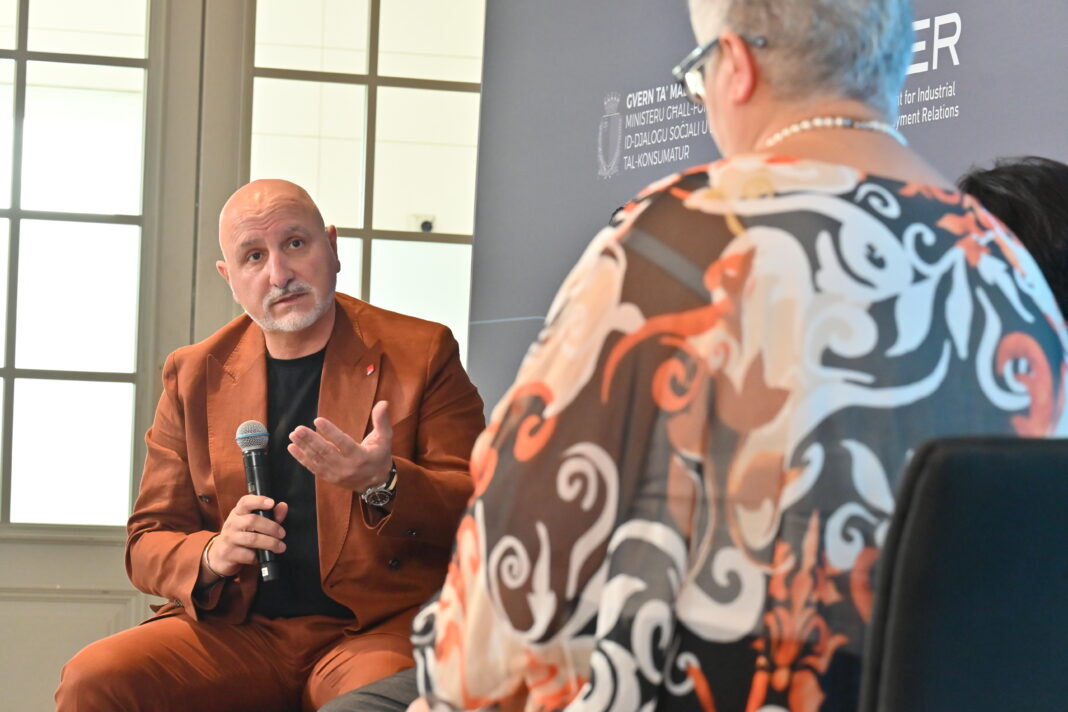
GWU Secretary General Kevin Camilleri stresses the importance of encouraging workers to speak up and ensuring workplaces have appropriate structures to prevent and address harassment.
The right of every worker to a safe, dignified workplace free from violence and harassment was at the centre of a seminar organised by the Department of Industrial and Employment Relations (DIER), under the theme “Safe and Dignified Workplaces for Women”.
The seminar was also attended by General Workers’ Union (GWU) Secretary General Kevin Camilleri, who, during a panel discussion, emphasised the importance of prevention, raising awareness and ensuring that individuals experiencing any form of workplace harassment feel confident enough to speak up and seek assistance.
Camilleri stated that, despite the progress achieved in this area, greater awareness and education are still needed. He stressed that workplaces must be equipped with the necessary tools, policies and structures not only to prevent violence and harassment but also to address any complaints appropriately and effectively.
The GWU Secretary General highlighted the sensitive nature of such cases and the importance of ensuring that every allegation is handled seriously, impartially and with respect for everyone involved.
In this context, he referred to a particular case he had encountered in which an individual had alleged harassment, but investigations subsequently revealed that the same individual had been responsible for the behaviour in question. He explained that such situations can have a significant impact not only on those directly involved but also on the wider working environment.
“The sensitivity of these cases, regardless of their nature, is an area where much more needs to be done, alongside our continued efforts to raise awareness,” Camilleri stated.
He explained that whenever allegations of harassment arise, clear and fair procedures must be followed, including appropriate investigations and, where necessary, disciplinary proceedings. In certain circumstances, cases may also be referred to the National Commission for the Promotion of Equality (NCPE) or the Police.
Camilleri also addressed the role of trade unions in such delicate situations, emphasising that their priority must be to safeguard workers’ rights while ensuring that every case is handled responsibly and fairly.
“As a trade union, we do our utmost to maintain harmony between both parties and explore ways of resolving the situation. However, we must also exercise caution, as not everything can be controlled,” Camilleri said.
He further emphasised the need for a balanced assessment of each situation, distinguishing between cases that genuinely constitute harassment and other workplace conflicts or disagreements.
The GWU maintains that prevention, education and dialogue are fundamental to building a culture of respect and dignity in the workplace. At the same time, every worker must be aware of their rights and have access to safe and confidential mechanisms for reporting violence or harassment without fear of retaliation.
The GWU’s message remains clear: every worker has the right to a workplace where they feel safe, respected and protected.