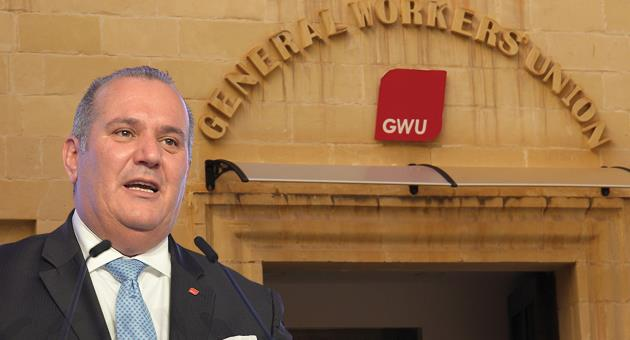
Outgoing Secretary General of the General Workers’ Union Josef Bugeja has reiterated his belief that the future strength of organised labour depends on widening union membership and collective bargaining coverage, particularly in sectors where workers remain most vulnerable to exploitation.
One of Bugeja’s most controversial positions has remained his advocacy for mandatory union membership with an opt-out mechanism, a proposal which he argues could significantly reduce workplace abuse.
After initially pressing forward with the idea, the government ultimately charged course, fearing legal backlash. Bugeja was where he drew the line between protecting workers and respecting individual choice.
“I still believe in it one hundred percent,” Bugeja told The Malta Independent on Sunday in an interview.
“If we had adherence, if employers actually adhered to Maltese laws, we wouldn’t need it. What we would need is discussion and improving working conditions, but the thousands of abuse and exploitation cases we deal with are far too many,” Bugeja said.
Gender pay gaps are one common factor where abuse takes place, and this is mostly so in sectors where union presence is limited.
“Financial and insurance sectors, for example, marked at 14%, because there is very little trade union presence there. If the role is the same, the wages should be the same, the basic principle is that pay is tied to the value of work, and it is in the law – and we agree with it so strongly that we have the phenomenon of ‘free riders,'” Bugeja said.
He said that when the union negotiated and achieved something for its members, non-members also benefit, because the laws apply to everyone.
“Why is that? Where else does one receive a service and not pay for it? Which other social partner provides a service and one doesn’t pay for it?” Bugeja said.
He said that one way or another, one should be organised, associated, or covered by a collective agreement.
Bugeja said the European Union is recognising that the way to increase wages is through collective bargaining.
Bugeja said that the union has been advocating for automatic enrolment from the start, and it is still ready to discuss it, whether other social partners agree with it or not.
Asked why he thought the government did not take this on board, Bugeja said he believed the government wants to look after its own considerations.
“I had full-blown arguments with the government. Right now, there’s a certain stability, a certain industrial peace, and what was publicly said was that government would do it and discuss it with the unions,” he said.
He said that something that relates to workers should not have needed to be discussed with employers.
“Employers took a position that they wouldn’t even discuss it at all and said they are against it. They brought up an element – and they know they were wrong, because we obtained our legal advice: the only issue in freedom of association is if I tell someone that they must join the General Workers’ Union – not that they must join a trade union of their own choice,” he said.
Bugeja said that if one still has the freedom of choice, it does not breach that principle.
He spoke of the many abuses the union faces, on bonuses being included in wages rather than have them be separate, or of workers having two separate contracts, one fake one to show to enforcement officers, and one real one, with longer working, unpaid hours.
“These are the kinds of things we deal with. How do you stop that? The issue is not just enforcement, it is adherence. I can stand guard over you all the time; the moment I turn my eyes away, you go and do something wrong. Where there is self-policing, where there is a collective agreement, these things get addressed,” he said.
Bugeja said he still believes that automatic membership is the way forward to cut abuse and raise standards.
The pandemic and energy subsidies
The most chaotic period of his tenure, Bugeja said, was the Covid-19 pandemic.
“There was no book, no model. The Prime Minister has to lead, but there was a direction the government knew it had to take,” he said.
He recalled being told that thousands of jobs would be lost, and that every family could face death.
Through wage supplements, emergency legislation and social dialogue, he said, mass unemployment was avoided.
Bugeja said that the GWU took the quarantine clause in old collective agreements and worked on it, till a legal notice came into force for quarantine if one has come in contact with a person who was sick.
He said that there was a sense of unity and solidarity, and everyone rose above themselves so that everyone could save their job and protect their families.
“We saw workplaces abroad, in other countries, where they promised a Covid wage supplement and then collapsed. Then came the war crisis and inflation, and electricity and water prices shot up. We saw the phenomenal impact in places like Germany, and then you compare that to Malta: the economy still grew and no one lost their job,” he said.
“Not only did people not lose their jobs, but even workers who had been irregular were registered,” he said.
That experience, he said, reinforced the union’s conviction that government could not step back during periods of systemic crisis.
One of the areas where Bugeja said leadership demanded difficult, often unpopular, judgement calls was the government’s decision to maintain energy and fuel subsidies during successive crises.
He rejected arguments that framed the issue in terms of national debt or long-term fiscal exposure, insisting that the debate had to be grounded in the lived reality of workers and workplaces.
Had the subsidies not been introduced, Malta would have faced an economic shock that many businesses, and workers, simply could not have absorbed, Bugeja said.
“There would have been an economic disaster. Workplaces would not have been able to carry that burden. It would have been impossible,” Bugeja said.
From the union’s perspective, the choice had been to either shield households and employers from sudden price shocks, or accept mass job losses and business closures, as had happened elsewhere.
On debt, Bugeja said that it becomes a problem when it cannot be paid, and the proportion to the economy matters.
“If the debt is at 45% right now, it is because our economy is so large. What would worry me is if, regardless of economic growth, the debt is at 70%,” he said.
Bugeja acknowledged that the subsidies came at a cost, and that national debt had increased as a result, however, the union had consistently prioritised social stability, as in his view, there was no alternative, as without the subsidies, households and businesses would have collapsed under sudden cost pressures.
Bugeja was one of the strongest advocates for reforming Malta’s minimum wage, which had remained stagnant for 27 years aside from COLA adjustments.
While acknowledging that workers had benefited financially with collective agreements, Bugeja said that economic growth had come at a human cost.
“Yes, there’s innovation, productivity, AI, but there is also stress, anxiety and burnout,” he said.
He was asked whether economic growth was being genuinely enjoyed by people on the ground.
“We are buying new cars, travelling more often, but when I go to work, how long am I working? What quality of life is that?” he said.
Bugeja said that sustainability had to be social, not just economic.
“It’s not enough to be economically sustainable – we must be socially sustainable too,” he said.