
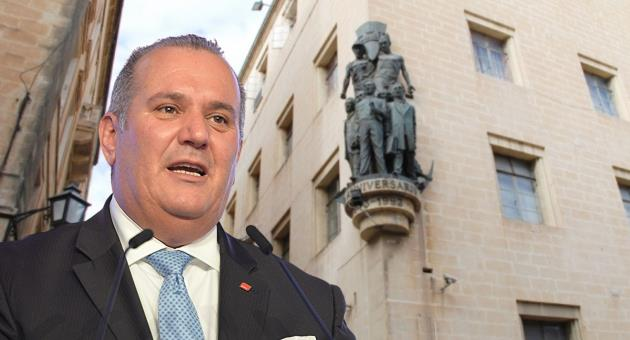
After more than a quarter of a century at the General Workers’ Union – and nearly 12 years at its helm – Secretary General Josef Bugeja has announced that he will step down, bringing to a close one of the most transformative and demanding periods in the union’s history.
In an extensive interview with this media house, Bugeja spoke at length about succession, institutional continuity, the battles he believes defined his tenure – most notably the protracted legal fight to retain the Workers’ Memorial Building – and why he believed this is the right moment to hand over leadership.
“From my very first day, I said one thing clearly: the organisation is bigger than any one person, including the Secretary General. Continuity and stability were always the most important considerations for me,” Bugeja said.
Bugeja explained that his decision to step aside was not abrupt, nor driven by crisis, but carefully planned around the union’s internal structures and electoral cycles.
Rather than vacating the post and triggering a leadership scramble, the GWU opted for a designated succession process, allowing for a phased handover.
That process, he said, is complex and deliberate. He said that the union’s internal governance requires elections every four years, starting from shop stewards, moving through delegates, secretaries, councils, executive bodies and, finally, confirmation at Congress.
Along the way, vacancies created by promotions must be filled in sequence, a process that Bugeja says involves four separate vacancies before a new Secretary General can ultimately be confirmed.
“That is why I said clearly that the process will take several months. It is not something you rush if you want stability. The handover has to happen calmly, transparently, and without tension,” Bugeja said.
For Bugeja, this approach mirrored his own rise through the ranks, from section secretary, to deputy, to designated successor, and eventually Secretary General.
“That is how continuity is protected. Not by waiting for a crisis,” Bugeja said.
At 57, Bugeja said his decision was shaped by both professional and personal reflection.
He described the modernisation of the union’s structures, the strengthening of its administration, and the stabilisation of industrial relations as milestones that convinced him the organisation was ready for new leadership.
“You reach a moment where you ask yourself: am I holding on to the chair, or am I acting in the best interests of the organisation?” he said.
He also spoke candidly about the personal cost of the role.
“For years, the union had my life, twenty-four hours a day. I missed birthdays. My daughter lives in the UK, and her birthday is on 3 October. The union’s anniversary is on 5 October. For eight years, I never celebrated her birthday because the union always came first,” Bugeja said.
That sacrifice was a conscious choice, but not one he wanted to extend indefinitely, Bugeja said.
“I believe leadership must change. Values remain, but the tools, the methods, the communication, those evolve,” he said.
A defining battle: the Workers’ Memorial Building
If one issue dominated Bugeja’s tenure emotionally, legally, and politically, it was the long-running court battle over the Workers’ Memorial Building, the symbolic and physical heart of the GWU.
He described the case as the single greatest source of anxiety he faced as Secretary General.
“I had a genuine fear that we could lose the building. Not because we had done anything wrong, but because court processes are unpredictable,” Bugeja said.
For years, the threat of losing the building loomed over the union, and Bugeja recalled sleepless nights before key rulings, imagining headlines announcing the loss of a landmark synonymous with the trade union in Malta.
“I remember imagining headlines: ‘Josef Bugeja loses the Workers’ Memorial Building.’ That thought haunted me,” he said.
When the court ultimately rejected the removal of the building from the union’s control, Bugeja said his relief was overwhelming.
“When the judge said that request number four – the removal of the building – was not upheld, I broke down. I cried. I couldn’t even hear the rest,” Bugeja said.
For Bugeja, safeguarding the building was not merely about property, but about institutional memory and identity.
“The GWU must always remain in that building. It is who we are,” he said.
Subsequent negotiations with government were guided by one principle: long-term stability, Bugeja said.
“We did not want the whole building. We wanted security, legal certainty, so that no future leadership would ever face this nightmare again,” he said.
Legacy beyond bricks
Beyond the building, Bugeja pointed to structural reforms that reshaped the union: the reorganisation of sections, the strengthening of international representation, and the integration of younger officials into leadership roles.
He highlighted major policy battles – the equal pay for work of equal value, the regulation of contractors, the recognition of platform workers, and Malta becoming one of the first EU countries to legislate protections for platform workers.
“Equal pay was a dream that took years of groundwork. We could not do it until we fixed the contractor system. That work was painful, technical, and necessary,” he said.
Bugeja also spoke of the union’s consistent stance on migrant workers.
“From day one, we said: a worker is a worker. Nationality never mattered,” he said.
Asked whether artificial intelligence represented a challenge or an opportunity for workers, Bugeja said it was “both.”
“It is not one or the other. The important thing is that we must prepare our workers for the change that is already happening,” he said, warning that workplaces were undergoing a complete transformation and questioning how ready people were to adapt.
He said AI would most significantly affect professional roles, citing an article by a Maltese academic which suggested that where companies once hired 100 junior accountants, they might now need only 50.
“It is professional people who will be affected within professional work,” he said, adding that while some roles would disappear, new opportunities would also emerge.
“We must start addressing workers’ skills, their competencies, their training and where we are going,” he said.
Bugeja said that nobody could predict what certain professions would look like in 10 years’ time, and that workers risked being trained for jobs that would no longer exist.
However, he said AI would create opportunities in automation, the green transition and other emerging sectors.
“These are changing workplaces too,” he said, arguing that Malta’s advantage lay in attracting high value-added industries rather than large-scale operations.
Smaller, innovation-driven workplaces, he said, could play a crucial role.
He pointed to examples in manufacturing, warehousing, pharmaceuticals and offices, where workers increasingly oversaw automated processes rather than performing manual tasks, with their skills focused on monitoring systems and repairing machinery when needed.
Bugeja spoke of the importance of preparation, citing a case where a sudden labour shortfall was addressed through rapid collaboration with MCAST and government ministries to create targeted training courses.
“That’s why we must prepare,” he said, noting that past delays in training, such as in nursing, had led to serious workforce shortages.
Ultimately, he said the key was lifelong learning. “Teach people how to use AI, how to use data, how to recognise what is good and what is bad. That is how they will be prepared for whatever jobs exist in the future,” Bugeja said.
Asked what he hopes his successor will embody, Bugeja cited empathy, solidarity, persuasion, and the ability to listen.
“You cannot lead a union without listening. Our policies are bottom-up. They come from the members themselves,” Bugeja said.
He said that the GWU’s leadership is not absolute.
“If two-thirds of delegates lose confidence, they can call a conference and remove you. That keeps you grounded,” he said.
As for his legacy, Bugeja was careful not to define it himself. Bugeja said he kept his decision private for a long time.
“I did not tell anyone,” he said. When he finally raised it during discussions about filling vacant roles, the reaction was immediate.
“I surprised and shocked everyone. They tried hard to convince me otherwise,” Bugeja said. However, his decision had already been made.
He will be remaining in office during the initial phase of the transition to ensure continuity and stability.
“What matters to me is that I am leaving an organisation that is stable, credible, and stronger than when I found it,” Bugeja said.
He said he will be stepping away confident in the team that remains.
“I leave with absolute trust in the administration – the president, deputy secretary general, the secretaries, the officials. The road we chose will continue,” he said.
For Bugeja, that continuity is the real achievement, as leadership ends, but the union must not.
“I have put the elements in place so that whoever comes next can make the union better than I did, and that, for me, is enough,” Bugeja said.